by Dawa Lokyitsang
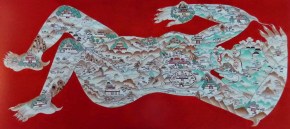
she realizes the demoness Srin, who represents the Tibetan landscape itself, is causing all the difficulties. To subdue her, they build a total of thirteen Buddhist temples, some of which still stand today in places like Bhutan (39), to pin her down on her back. Four in the inner realm of Tibet to pin her shoulder and hip. Four at the border areas, pinning her knees and elbows. Four at the boarders beyond to pin her hands and feet. And finally, one at the Jo-khang, symbolizing her heart and considered the center of Tibet (38). Thus Srin is subdued and Buddhism can reign over Tibet. Besides Buddhist domination of Srin, what is this myth really about? And why is the demoness gendered as female?