Decolonizing “Tibetan” and “Himalayan” Studies: Empire, Ethnicity, and Rethinking Sovereignty, an Introduction
The Oxford Handbook of the Himalayas, edited by Amy Holmes-Tagchungdarpa, was recently published by Oxford University Press. The volume is available electronically through Oxford Academic, the physical book will become available in print September 1, 2026.
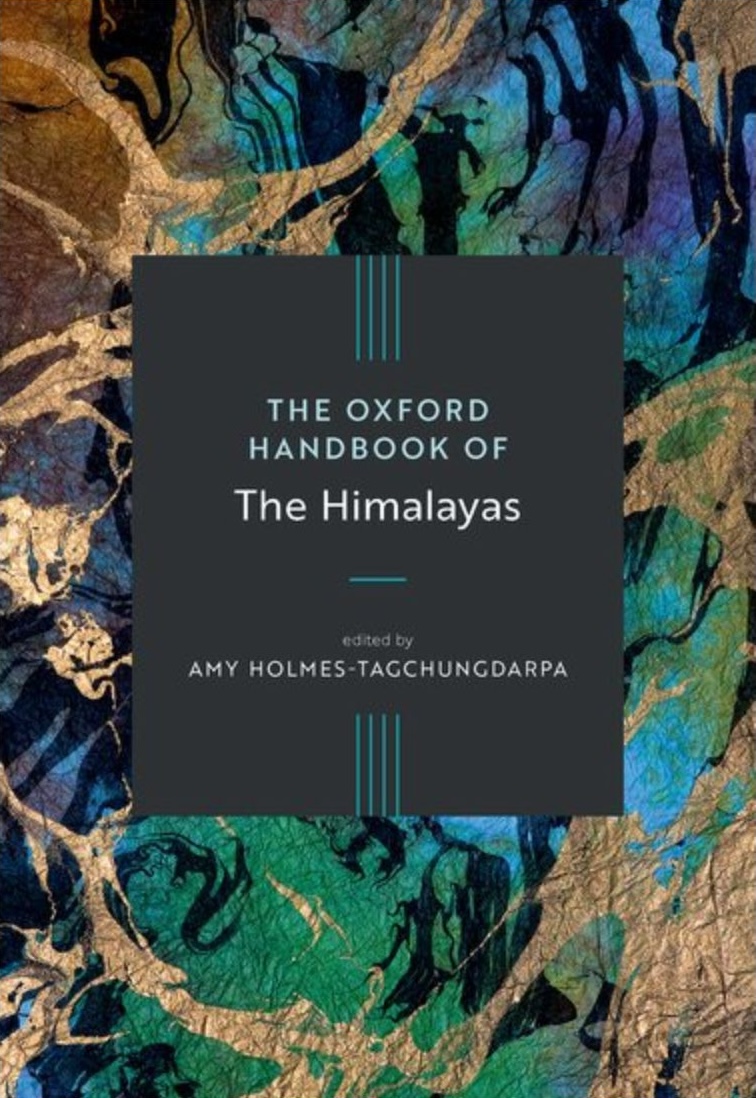
My chapter, “Decolonizing ‘Tibetan’ and ‘Himalayan’ Studies: Empire, Ethnicity, and Rethinking Sovereignty,” appears in the introductory section of the book as Chapter 3. PDF available for download through your institution login on the OUP website.
I’m making this chapter available here on Lhakar Diaries in light of recent developments — including China’s “Ethnic Unity and Progress” law, which went into effect on July 1, 2026; Lobga Rangzen’s self-immolation on July 2nd, 2026 in front of the United Nations in New York in protest of that law; and Kathmandu University’s cancellation of the International Association of Tibetan Studies (IATS), reportedly under pressure from the Chinese government on Nepal’s new GenZ-elected Shah government.
The chapter highlights how these events, taken together, are part of a much longer history — in the aftermath of China’s 1950 invasion of Tibet — of national standardization practices: efforts by multiple states, including China, India, and Nepal, and to an extent Bhutan and Myanmar, to fix and govern “ethnic” categories. It traces how this standardization of “ethnicity” — by states and scholars alike — developed out of the epistemic and political logics of Western Tibetan and Himalayan Studies, which was itself constructed out of the imperial rivalries — British, Russian, and Qing — that shaped the region.
Rather than posting the entire chapter at once, I will share it section by section over time. Please check back periodically for updates.
To begin, here is the Introduction section of the chapter.
***
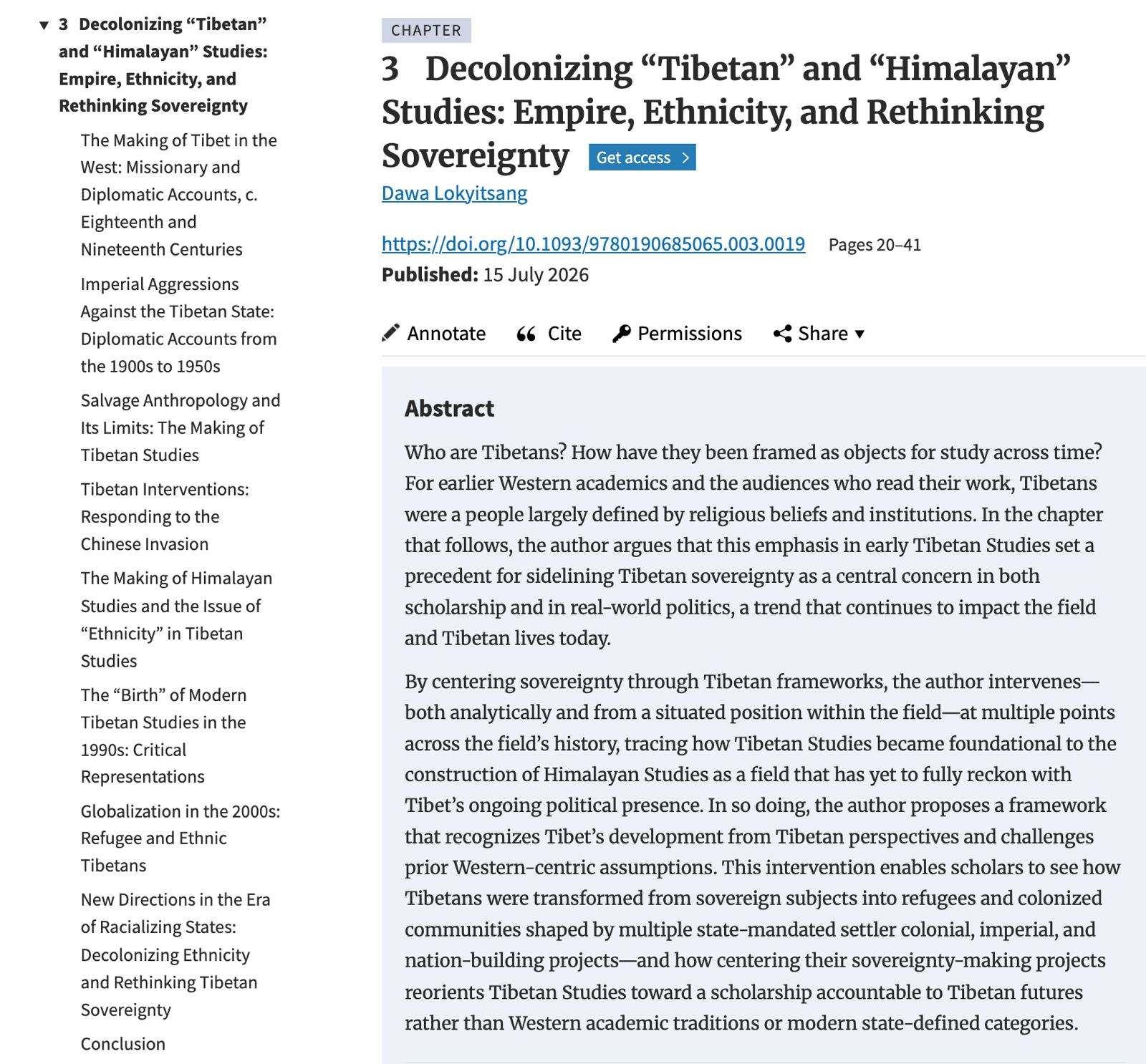
Who are Tibetans? How have they been framed as objects for study across time? For earlier Western academics and the audiences who read their work, Tibetans were a people largely defined by religious beliefs and institutions. In the chapter that follows, I argue that this emphasis in early Tibetan Studies set a precedent for sidelining Tibetan sovereignty as a central concern in both scholarship and in real-world politics, a trend that continues to impact the field and Tibetan lives today.1
Where researchers did engage sovereign institutions, their Orientalizing renderings marginalized Tibet’s geopolitical history and developments in Central Asia as an empire and nation. This obscured the rich body of Indigenous history transmitted through literary and oral traditions that Tibetans had produced for their audiences over centuries, building on earlier Tibetan works.2 An alternative framing of the field’s history, one that centers sovereignty through Tibetan frameworks, offers Tibetan Studies a means of understanding its development from Tibetan perspectives. In doing so, it also traces how Tibetan Studies became foundational to the construction of Himalayan Studies as a field that has yet to fully reckon with Tibet’s ongoing political presence within its own borders and scholarly frameworks. Throughout, I mark specific moments of intervention—points where centering sovereignty reframes what prior scholarship has taken for granted—in order to make visible the cumulative weight of these oversights and what correcting them makes possible for the field.
This chronological examination of scholarly productions on Tibet undertaken predominantly by Western scholars reveals the making of Tibetan Studies as a Western academic subject based on ideas and interpretations of Tibetans by outsiders. Similarly, modern Chinese scholarship on Tibet has been heavily influenced by Orientalist Western traditions—a legacy that continues to shape state-sponsored knowledge production on Tibet today, with concrete consequences for Tibetan scholars and communities.3 Both trajectories underscore the importance of acknowledging histories of representation,4 particularly given that “Tibetan” and “Himalayan” are themselves historically constructed categories, shaped by imperial knowledge production, state classification practices, and competing political claims.
Tibetans entered the field as native scholars writing in English at first in response to Western Orientalist accounts of Tibetans5 and later in the 1960s following the PRC’s occupation and colonization of Tibet. Since the turn of the twenty-first century, a focus on modern Tibetan communities through the frameworks of religion, ethnicity, and diaspora have revealed the complexities of Tibetan societies. An alternative framing of the history of the field that centers sovereignty through Tibetan frameworks offer Tibetan Studies an avenue for centering the development of Tibet through their own making. Doing so allows for Tibetan Studies scholars to recognize the making of Tibetans from sovereign subjects into refugeed and colonized subjects who are impacted by state-mandated settler colonial, imperial, and nation-building projects—and to examine how Tibetans continue to exercise their own sovereignty-making projects.
My focus in this article is on the social sciences—anthropology, geography, and political science—and the development of Tibetan Studies in the United States. That said, my analytic eye is also turned to Buddhist and literary studies and to scholarship produced in Asia and Europe, and many of the arguments I make here are also applicable in those domains.
A note on positionality: I write this chapter as a Tibetan scholar working within the very field I am critiquing. This position is not incidental to the argument—it is constitutive of it. The interventions I mark throughout are not only analytical moves but also enactments of the kind of sovereignty-centered scholarship I am calling for. This also means taking seriously Tibetan-authored scholarship not as data or local knowledge but as theoretical and analytical contributions—a demand this chapter both makes and models. Following Linda Tuhiwai Smith, I understand decolonizing not only as critiquing imperial origins but as actively reorienting the field’s frameworks and citational practices toward Tibetan narratives, oral traditions, and histories of survivance,6 and political self-determination—which means that historicizing how Tibetan and Himalayan Studies emerged from Western imperialism and Chinese colonial invasion is itself a decolonial act.
It is from this position that I propose a framework for understanding Tibetans not merely as ethnic or refugee subjects but as agents whose political, cultural, and social projects persist despite state and imperial pressures—one that allows Tibetan Studies to move beyond Orientalizing legacies and foreground Tibetans as active agents in shaping their own collective histories, presents, and futures.
Pingback: The Making of Tibet in the West: Missionary & Diplomatic Accounts, c. 18th & 19th Centuries, SECTION 1 in DTHS