Upholding the Pledge: Lhakar in 2013
Happy 2013 to all our readers out there! Now that the holidays are over it’s back to work here at LD. After a long and busy holiday I thought what better way to… Continue reading

The following is a short interview I did with Phayul Media, the popular Tibetan news platform based in Dharamsala, India, in the summer of 2022 (they published it a year later in 2023).… Continue reading

Happy 2013 to all our readers out there! Now that the holidays are over it’s back to work here at LD. After a long and busy holiday I thought what better way to… Continue reading
What does an ethnographic discourse on the invisibility of a colonial empire in the 21st century look like? What does that invisibility contribute to, or rather take away from, the experiences of Tibetans inside and outside Tibet? In this post, I examine the historical and contemporary discourses on Tibet that frame Tibet as either not colonized or about human rights, which, I argue, silences Tibetan aspirations for Nationhood. Aside from contextualizing Tibetan subjectivities, I contribute to the ongoing discourse on how ethnographic narratives can re-construct the invisibility of existing colonial empires and justify their presence as a given right rather than foreign.
In a town like New York City, art openings are as plentiful as potholes. But a show like Art for Tibet, where artists from around the world donate their one-of-a-kind works for the Tibetan… Continue reading
For the past month, as the number of self-immolations climbed, my adviser and I sat down several times, trying to figure out activities we can do to highlight the situation better here at the University I’m currently studying at. Then last week, I saw the video campaign with messages to world leaders launched by SFT spreading in the web-sphere.
Bay Area Tibetans at the University of San Francisco gather to see Daw Aung San Suu Kyi The following post was submitted to Lhakar Diaries by Dechen Tsering from Berkeley, California. She is… Continue reading
This past week, I saw the film ‘Death by China’. This film is based on the book written by Peter Navarro and Greg Autry. I didn’t know what to expect going into this… Continue reading
Ben Hillman–a Senior Lecturer at the Crawford School of public policy, Australian National University–wrote an article called “China’s many Tibets: Diqing as a model for ‘development with Tibetan characteristics?’” (2010). He details the economic success, through the government-funded tourist industry, of Shangri-La, a Tibetan town in Kham, as a model that the Chinese authorities can follow for “China’s many other Tibets”. However, in his eager attempt to support his argument for Shangri-La as a successful model, Hillman fails to acknowledge China’s historical role in that region, the popular resistance that occurred before and during the time period he covers, or further analysis of local involvement in the tourist industry.
Earlier this month, I took a little weekend trip to Montreal, in the province of Quebec. While Ottawa, where I live, is a city that is more or less bilingual with most people… Continue reading
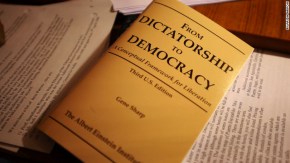
Since 1980 dictatorships have collapsed before the predominantly nonviolent defiance of people in Estonia, Latvia, and Lithuania, Poland, East Germany, Czechoslovakia and Slovenia, Madagascar, Mali, Bolivia, and the Philippines. Nonviolent resistance has furthered… Continue reading
Recently I went to my university library to look for its Tibet section and found that there was so much literature, specifically contemporary literature, lacking. Sure there were some books that I was… Continue reading