Ocean, as Much as Rain: Woeser’s Testimony of Resistance Against State-imposed Amnesia by Thinley Chodon
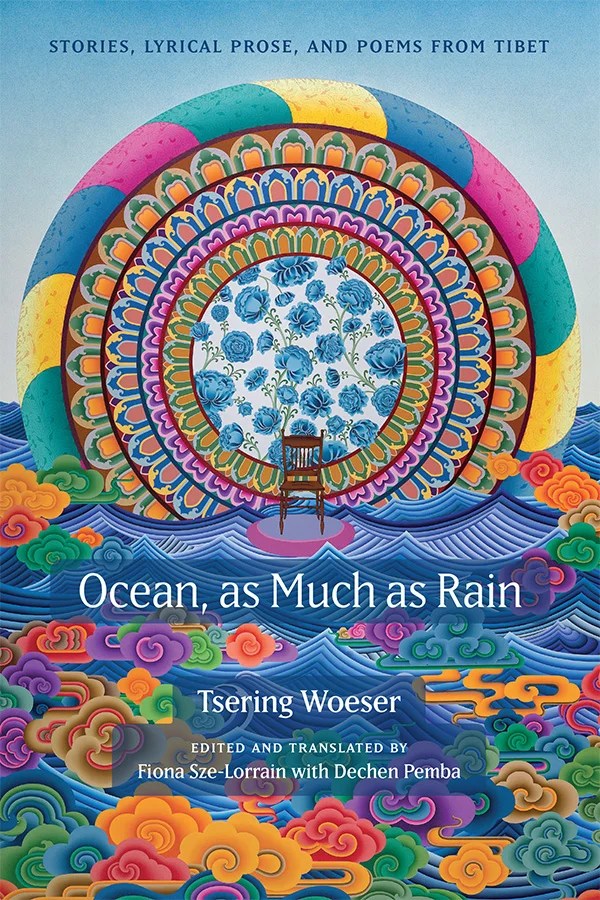
Woeser’s Ocean, as Much as Rain opens with a poem that accurately sets the tone for the rest of this translated collection: “A sheet of paper can also become a knife even sharper”. Demonstrating her unique positionality and resistance from the very beginning, Woeser’s dissidence is louder than the Chinese colonial state’s violent imposition of silence, surveillance, and erasure.
Ocean, edited and translated from Chinese by Fiona Sze-Lorrain with Dechen Pemba, is the first ever English translation of the collected works of Woeser’s cross-genre writing that ranges from lyrical prose, poetry, reportage, photography, and testimony announcing Woeser as a truth-teller who observes the absurdity that has become the reality of occupied Tibet. While Woeser looks inward in many pieces and asks “how can I open my Tibet”, much of her writing to date has provided a searching critique of the socio-political and cultural invisibilisation of Tibetan existence. In Ocean, Woeser provides an insurgent counter-archive of Tibet under an oppressive regime, and in doing so, also draws attention to the Tibetan voices that have encouraged her to continually make and re-make Tibet’s collective memory. “Life brims with incredible encounters”, Woeser notes in her eponymous essay. Indeed, these encounters are almost never coincidental, and almost always a carefully planned, tender yet fierce engagement with Tibetan and dissident Chinese voices that further enable her mission to open her Tibet to the world and build transnational solidarity.
Many readers already familiar with Woeser’s work will know that she is no stranger to oppressive state surveillance. Her earlier best-selling prose collection, Notes on Tibet (2003), was banned and condemned by the Chinese state for its “forbidden subject matter”, a description that not only reveals China’s censorship and hyper-surveillance practices, but also the construction of contemporary authoritarianism. Writing in the post-Tiananmen Square massacre period, many of Woeser’s pieces uncover what Banerjee (2025) calls “cognitive warfare” in the Tibetan plateau where Tibet is “not just militarised; it is being narratively re-engineered” through China’s information warfare which controls all information.[1]
In her poem “Let Me Write, the Fear of Lhasa Breaks My Heart” and the essay “My Tongue Surgery”, Woeser highlights that surveillance in Tibet is not only physical—excessive planting of cameras, soldiers, checkpoints—but epistemological. Typical to how surveillance functions, Woeser highlights how propaganda has become the voice of the Chinese Communist Party as it has historically enforced the complete crackdown on individual and collective activities of Tibetans, wiping out any information about the Tibetan movement, monitoring digital spaces where language and terminology are policed. In “My Tongue Surgery,” Woeser confronts what she calls “existential displacement”—an embodied metaphor for the socio-political and cultural erasure of Tibet where the CCP’s “cognitive warfare” operates by dissolving the vocabulary of dissent. Tibetan writers like Thubten Samphel (in Copper Mountain 2021) have also talked about the compilation of banned words in the wake of the 1989 pro-democracy protests headed by “Tibet, Tiananmen, Taiwan, the Dalai Lama, independence, democracy and human rights” (172). What occurs here, is the registration of state propaganda which seeps into all aspects of the Chinese cultural environment including the media. Free press becomes an anomaly and the state’s stronghold over media is represented through the selective use of national media to cover major events. In response to this, since 2008, Woeser has declared herself an independent writer and blogger, arguably becoming the most active Tibetan blogger of our time. In Voices from Tibet (2014), she describes her mission as giving “voice through as many channels as possible—books, blogs, radio programs, Twitter [now X], Facebook and press interviews,” calling herself a “one-woman media” in a region where every form of journalism operates as a propogandist state apparatus. Indeed, Woeser has emerged as a “visual chronicler” as well as parallel press.
Amidst the upheavals in Woeser’s personal life, much of which spills into every story, poem, photograph and conversation, Ocean is not only a scathing critique of Chinese colonialism. It is also a testament of Tibetan solidarity, strength, and a call to action which—as Woeser herself identifies in “Garpon La’s Offerings”—is built on the foundation of collaborative and collective action: “…I must say, that the only reason I am able to enter, even temporarily, the collective memory of these events is because of the help I’ve received from those who survived”.
Woeser holds a mirror to our current reality and urges readers in “The Prayer Beads of Fate” to step away from their isolated lives of privilege and blindness and emphatically asks a question we must all reckon with, especially now: “How do those who seem to be of this world/manage to live peacefully/ in huts full of pure sounds/ their only home?”. In addition to the political fervour in her writing, Woeser’s work has always been a beacon of hope and solidarity that transcends geopolitical borders. Not only does the poem provide a chilling reminder of the violent regime that oppresses Tibet, it addresses the urgency for transnational solidarity in an age of genocidal ambitions and authoritarianism. Applicable not only to Tibet, but the many colonialisms and oppressions that continue to destroy entire communities and nations, how do we continue to live peacefully while Palestine is erased, Sudan is silenced, Iran remains unheard?
In an effort to dismantle colonial impositions and conventions—whether in her writing, way of life, or philosophical engagements—Woeser breaks away from the numbing condition that robs us of all empathy in the contemporary world. She rejects linear narratives, singular identities, and fixed ideas surrounding Tibet. In “Rinchen the Sky-Burial Master,” she dismantles the exoticised Western gaze on Tibetan rituals. A sky-burial master is not a mystical relic but a layperson, often with low social status—sometimes even a civil servant or former monk—who performs the sacred ritual of sky-burials which allows for the dead to pass on to another life. Woeser’s interactions with Rinchen, once a monk of the Tsurphu Monastery who later joined the Chinese Communist Party, is a rare story rooted in empathy, Tibetan-Buddhist spiritual practices and epistemology. In the essay, Rinchen tells Woeser that the most popular Communist Party slogan is “serve the people”. He further adds: “To be a tokden (sky-burial master) is serving the people”. Woeser discloses how the Tibetan nomad reinterprets the Maoist doctrine more faithfully than the state itself and embodies the ideology of service through ethical action and Buddhist compassion, inspired by the story of the Buddha feeding his body to a hungry tiger.
Woeser sees herself mirrored in the plural identities of people like Rinchen: “It is precisely the pluralism of their identities that turns a great many Tibetans into two, three persons.” Like Rinchen, and like Karma in “The King of Dzi”, Woeser too occupies many (often contesting) identities as a party-member’s daughter, banned writer; insider and exiled; citizen and stateless. Colonial modernity, as Woeser demonstrates through her writing with repeated efficacy, splits the self.
However, despite such tears, gaps, and holes in Tibet’s history, the accomplishment of Woeser’s writing is the hope that threads through her work. In her retelling of the Cultural Revolution’s destruction of the Jokhang monastery in “Ocean, as Much as Rain”, she recalls the period when, on August 24, 1966, Red Guards—teachers and students alike—marched with portraits of Mao to eradicate the “Four Olds.” While sacred statues were smashed, murals scraped into mud, texts burned, amidst the violent destruction, clandestine acts of devotion cemented Tibetans’ unwavering hope of envisioning a liberated Tibet. A former monk-turned-Red Guard hid a Buddha’s head and later smuggled it to Dharamsala, offering it to the Dalai Lama. Ruined Buddha faces travelled secretly through Nepal to India. During renovations in Dharamsala, workers struggled to sculpt the idol of the Avalokiteshvara until, in a “fitting and marvelous” synchronisity with the statue’s destruction in Tibet, they finally succeeded—as if, Woeser suggests, the soul of the deity had “travelled from Chinese-ruled Tibet to the other Tibet in India”.
Woeser threads these true stories together to give voice to metaphysical continuities which turn into resistance amidst the geopolitical reality of the loss of material sovereignty. In “Remembering a Smashed Buddha”, Woeser contextualises how sacred idols and artefacts are not only Tibet’s material possessions but are remnants of ancient Tibetan beliefs now reduced to Chinese capitalist commodities displayed and for sale alongside “soy sauce, bean paste, salad dressing, and rolls of toilet paper”. Woeser’s critique further extends to the spectacle of modernisation. During the 2008 Beijing Olympics, “international business cities” rose in Tibetan villages, plastered with advertisements urging residents to “occupy the place, hold the hinge”. Always attentive to colonial language in the guise of development, Woeser exposes how the economic zones promised wealth while displacing Tibetan villagers from their ancestral lands.
Absurdity is the new reality of Tibet. Woeser’s Lhasa, “now a city of fear,” is often saturated with soldiers and plainclothes agents. Imprisonment and torture of monks, nuns, students, journalists are not aberrations but structural features of Chinese occupation.
Yet Woeser insists on indigenous epistemologies that defy colonial temporality. “In Tibet, time behaves differently,” she writes. This is not Shangri-La exoticisation but a rejection of capitalist linearity within Woeser’s writing too. Time bends “like a wire bent into a circle”, and colonial-capitalist notions of temporality are vehemently rejected. In her encounters with Tibetan people from different walks of life, Woeser also intersperses her realist writing with the rich traditions of Tibetan folklore, mythology, and legends that have tied Tibetan communities to their lands, mountains, rivers, and ancestors for the length, breadth, and depth of a time that the linearity of a colonial-capitalist regime is neither able to imagine nor contain.
Tibetan traditions, such as reverence for Yida, protector of animals and plants, demonstrate Tibetan environmental ethics wherein animist practices and co-existence with the environment have been a central part of Tibetan epistemology for centuries. In an era of resource imperialism, extractivist practices and consequent ecological collapse, such cosmologies are not merely residues of ancient culture but provide alternative ways of existing with ecology.
Towards the latter half of Ocean, we peek into Woeser’s photographic practice that she calls “ruins photographs” that further resists erasure. Ruins personify “a city within a city, a people within a people.” A dead spider hanging mid-air, weeds cracking clay floors, these details become Woeser’s visual testimony of a Tibet that exists no longer but resists through the stories that these ruins contain.
In “Only This Useless Poem—for Lobsang Tsepak,” she writes: “They always want to make you think that speaking out is useless/ But we must not stop speaking out! … Both hands empty/ my right hand grabs a pen, the left holds memories.” A fierce voice in the genre of testimonial literature, Woeser’s Ocean, as Much as Rain details a dissident writer’s resistance of the amnesia imposed by the Chinese state. This translated collection is a work powered by collective memory, collaboration, and the strength displayed by Woeser and many other Tibetans who continue to speak truth to power. Ocean is triumphant in its call to action and further fuels the Tibetan liberation struggle by rejecting compliance with China, and challenging a state that reduces Tibet to Shangri-La mythology, a museum of ancient relics, and/or a capitalist market for consumption.
To conclude, while Woeser calls March “the cruellest month,” Ocean is a reminder that it will always bear witness to the Tibetan uprising in 1959 and the Tibetan independence movement that continues today, sixty-seven years on, and until Tibet is free.
[1] Banerjee, Aritra. “The War for Tibet’s Story: Reclaiming Identity in an Age of Algorithmic Occupation.” Tibetan Review, 26 October 2025, https://www.tibetanreview.net/the- war-for-tibets-story-reclaiming-identity-in-an-age-of-algorithmic-occupation/ Accessed 12 Dec. 2025.
Thinley Chodon is a PhD Candidate at the School of English, Drama & Film at the University College Dublin, Ireland.
Pingback: Order Information for “Ocean, as Much as Rain” By Tsering Woeser