How do we Tibetans create our own Place? Why should it matter?

HH Karmapa performing Cham
Cham:
How do Tibetans construct their own space and place, and what role does cham have in this process? While there are many socio-cultural ways in which Tibetans create and shape their own places, I focus here on how they do so through the masculine ritual practice of cham. I describe it as masculine because cham has historically been performed by a caste of Tibetan Buddhist monks—and, more recently, by some nuns—but for the purposes of this discussion, I will focus on the men who have traditionally dominated this ritual.
Among the many meanings accorded to cham, the ritual is a dance that reenacts the heroic story of Padmasambava (Guru Rinpoche) in Tibet, the revered tantric teacher from Swat Valley (in modern day Pakistan) who came to Tibet at the invitation of King Trisong Detsen. Padmasambhava is credited with taming the deities of the Tibetan landscape and helping to spread Buddhism across the plateau. Beyond its historic retelling of Padmasambhava, cham is also a public ritual performed every Tibetan New Year for a variety of purposes too numerous to list here.
During the most recent Tibetan New Year’s cham ritual in Nepal, I was told by another Tibetan that one of the ritual’s functions was to purify collective karmas and remove obstacles in preparation for the new year. This continual need to purify spaces through cham at every monastery reflects the belief that human and demonic agencies are constantly infiltrating the sanctified spaces of both monasteries and the towns that surround them.
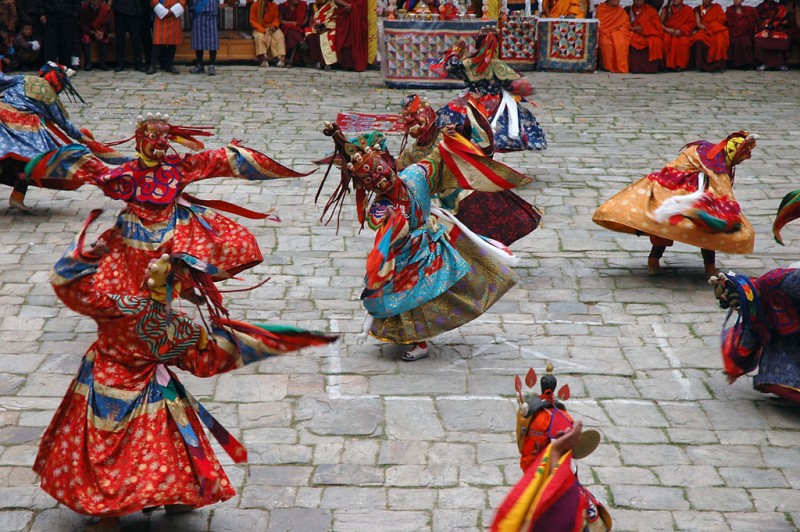
Cham Dance in Bhutan
During cham, the Lama—the monastic head—acts as the initiator of the ritual. Without him, the performance cannot take place. Throughout the cham, the Lama positions himself at the center while his assistants surround him, collectively visualizing themselves as forming a mandala. In Buddhist symbolism, a mandala is a geometric figure representing the universe.
The Lama envisions himself as the Chakravartin, the benevolent ruler of the universe who governs both social and political space. He then invokes the deities who inhabit the surrounding mountains, bringing them down to the ritualized mandala ground he has constructed, and begins to embody these deities. Using a tantric dagger, he performs the ritualized act of taming them. By straddling the human and deity realms, the Lama ritually tames the land through the subjugation of its deities and renews the relationship humans share with these spiritual beings. Charlene Makley calls this process “mandalization” (2007: 53).
It is therefore unsurprising that Tibetan Buddhist landscapes—both ritual spaces and physical places, such as monasteries and towns, inside and outside Tibet—are often constructed in the image of mandalas. As the initiators of such spaces, Lamas occupy a central role in shaping how Tibetans understand and define their landscapes in Buddhist terms. Recognized as “divinized embodied agents operating from the center of a mandala,” Lamas are seen as capable of dominating the deities of the land, positioning them as ultimate exemplars of Tibetan masculinity.

Mandalized architecture and landscape in Gyantse, Tibet
***
Labrang:
In Fatherland, Makley focuses on Labrang Monastery in Amdo prior to the invasion by Chinese Communist military forces in 1949. The first Lama, Jamyang Shepa, founded Labrang in 1709. Due to his hyper-masculinized role as head of the monastery, he determined, as Makley argues, the sociospatial relationships Labrang maintained with both smaller and larger neighbors, including the Qing Empire. Under the masculine authority of the Jamyang Shepas—revered by the public for their spiritual and political abilities—Labrang became a bustling spiritual and economic center (Makley, 2007: 59).
This role also enabled Labrang, Makley argues, to function as a fiercely protected autonomous area, independent from Lhasa or Qing oversight. The monastery’s sacredness and economic success attracted nomadic tribes, who, motivated by the desire to be in close spatial proximity to the Lama and his monastery, settled permanently outside the monastic compounds. These settlements formed a ripple effect that extended the mandalized infrastructure of the monastery into the surrounding landscape.

Labrang Monastery in Amdo, Tibet
During the annual cham festivals, in addition to local inhabitants, many nomadic tribes from distant regions converged on Labrang to observe and participate in the two-week celebrations. Beyond the hyper-masculine role assumed by the Lama during the cham ritual, Makley highlights other spaces of prestige and masculinity in which non-monastic men could participate. Public displays of affiliation and loyalty to the monastery and its figures—through gift offerings—could, as Makley argues, enhance their own masculine status. During the festivals, “tribal leaders vied with one another to demonstrate their political prowess by donating the most and best items of food, butter, meat, and money successfully collected from their constituents” to the monastery (Makley, 2007: 69). The donated food was then freely redistributed to the public during the two-week prayer sessions.
Another method through which the Jamyang Shepas sought to “recruit and regulate” the participation of lay male patrons from politically powerful families was by assigning them “prestigious supporting ritual roles” as a public reward for their patronage. Their responsibilities included patrolling the town and monastery during the festival. These roles, Makley notes, “literally mandalized key laymen,” ensuring their continued loyalty and support for the monastery. Such prestigious roles, bestowed by the Lama, further masculinized their stature among the public.
However, with the arrival of the Chinese Communist Party (CCP), this entire system of ritualized prestige and masculine social order was disrupted.
***
Destruction of Tibetan Places:
For communist China, Tibetans were a barbaric and backwards people. Unlike the Buddhist Qing China, ‘liberation,’ according to the atheist new communist republic, was not achieved through tantric rituals and practices, but through the rationalized socialist idea of modern progress. When socialist China invaded, its forces settled in major urban Tibetan areas such as Lhasa, the capital city and the seat of the Tibetan government, as well as the location of many of Tibet’s most sacred monasteries. They did so because traditional authority figures, such as Lamas, and their sacred monasteries were located there. During a brief, enforced period of collaboration between the Lamas and the Chinese Communist Party (CCP), the first thing soldiers of the People’s Liberation Army (PLA) did, according to local Tibetans, was build roads and landing strips for airplanes.
While Tibetans tamed their land through tantric Buddhist mandalization, socialist China sought to tame the Tibetan people and their land using socialist ‘modern’ technology. Lefebvre (1991), Harvey (2006), and Smith (2008) reflect on roads as a technology designed by capitalist states to eliminate the obstacles of distance and assist in its project to remake space in its own image. For socialist China, roads were essential for consolidating control over regions traditionally ruled by the Tibetan elite, enabling the transport of Chinese soldiers and the remaking of Tibetan spaces into socialist ones. After failed attempts at collaboration, Chinese socialist authorities targeted the Tibetan Lamas, arresting, torturing, and killing them—actions that provoked widespread rebellion among the Tibetan public.
Socialist China responded by bombing Tibetan monasteries that Tibetans held sacred—an act of war, according to Tibetan resistance fighters. In this wartime context, using the very roads they had forced Tibetans to build, Chinese troops and weaponry were deployed, and the war they initiated to invade Tibet was ultimately won. This war on Tibetans and their mandalized places continued until the end of the Cultural Revolution, by which time China had succeeded in razing nearly all of Tibet’s most sacred monasteries to the ground. Tibetan places were then incorporated into and reordered as socialist spaces, a process Charlene Makley identifies as the emergence of a ‘communist sociospatial order.’ Under these state-enforced socialist transformations, the existing masculine roles of Tibetan men—and their relational ties to the feminine—along with the spatial imaginaries and prestige systems grounded in Tibetan cultural conceptions of space and place, were effectively eliminated.
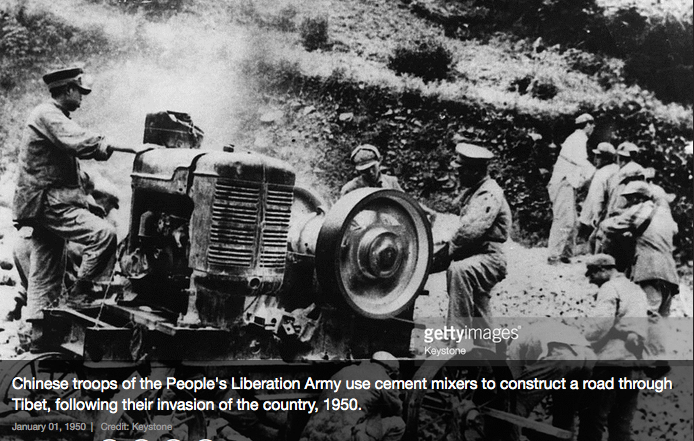
Chinese troops building roads in Tibet
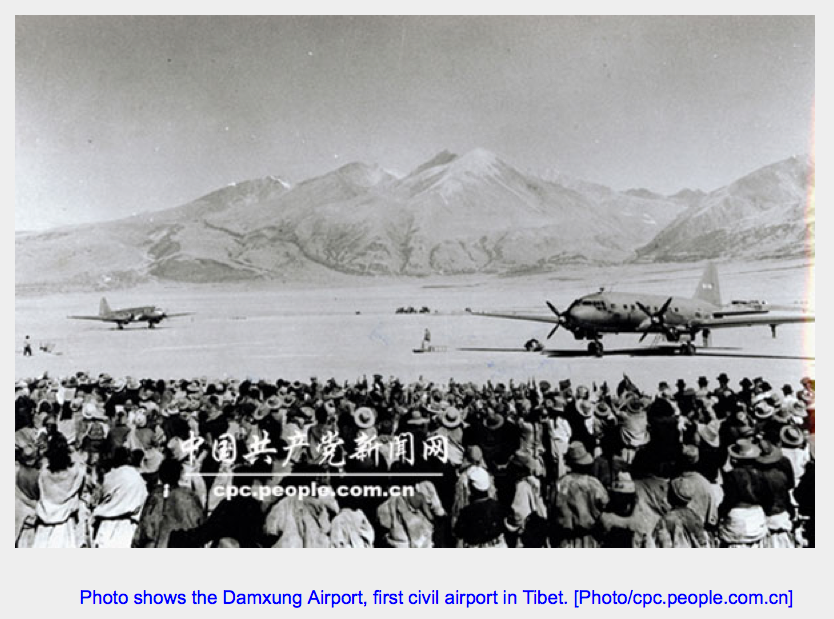
Chinese-built airport in Tibet
In 2000, however, socialist China launched its ‘Go West’ campaign to stimulate development and capital accumulation in its peripheral colonized regions, including Tibet and East Turkistan, the homeland of the Uyghurs. Following China’s successful adoption of capitalism in the 1980s and the massive transformation of its mainland cities into industrial hubs, the state turned its attention to its colonized frontier territories. The Go West campaign intensified existing urbanization programs already underway in places such as Lhasa and expanded them to target rural Tibet and its natural resources.
Under this campaign, Tibetans were permitted to rebuild their destroyed monasteries, but primarily for tourist consumption, as tourism generated high revenues. Tourist-based development initiatives were expanded, using Lhasa—one of the first Tibetan cities transformed under Chinese socialist rule—as a blueprint for reordering other Tibetan towns. These towns were to be urbanized and incorporated into a broader strategy of capital accumulation.
In Kham, the place where my grandfather was born and raised was renamed Shangri-La—from its original Tibetan name, Gyalthang—in the mid-1990s to attract Chinese-led tourist initiatives. The term Shangri-La is a mispronounced and Anglicized rendering of the Buddhist Shambala (‘place of peace’) coined by British orientalist writers who had absorbed too many romanticized memoirs about adventures in Tibet written by British colonial officers involved in the 1904 invasion. That invasion, in turn, heightened longstanding Chinese insecurities and contributed to later efforts to claim Tibet as a colony—but that is another imperial story for another time.
By the end of 2006, China had completed its railway from Beijing to Lhasa, followed by a state-backed campaign—supported with financial incentives—to encourage permanent Chinese settlement in cities such as Lhasa. This influx has produced extreme class disparities not only between Chinese settlers and Tibetans, but also among Tibetans themselves, deepening divides between the wealthy and the poor. With the continued construction of roads and other transportation infrastructure, state-owned industries in mining, damming, and related enterprises began proliferating across the grasslands.
Under the banner of development and modernization, the Chinese colonial state began removing and displacing Tibetan nomads from their communally held grasslands and forcing many—especially the poorest—into urban enclaves, where they became dependent on wage labor and cash income, something their pastoral livelihoods had never required. Justifications for these projects, building on the original rationale for the invasion of Tibet, drew on an age-old imperial ideological argument: that the so-called ‘backward’ native population lacked the sophistication to generate surplus value from their land.
Such ideological claims, as Wood (1999), Cruikshank (2006), and Teaiwa (2014) argue, enable the construction of legal frameworks that serve to legitimize the colonial appropriation of Indigenous spaces—both ideological and material.

Tibet Railway
***
Tibetan Responses:
In this process of ‘accumulation by dispossession’ (Harvey, 2006), Tibetans have responded in numerous ways and to varying degrees. These responses can be understood as what Lefebvre terms ‘differential spaces’ or what Harvey calls ‘alternative spaces’ of revolt.
In 2008, I witnessed the largest Tibetan uprising ever recorded in Tibetan history. The rebellion lasted for several months. It began in Lhasa and quickly spread across the Tibetan regions of Amdo and Kham. The Chinese military was deployed, and the uprising was forcibly suppressed. Then, beginning in 2009, monks—followed by nuns, teenagers, nomads, mothers, fathers, and elderly men and women—began setting themselves on fire in protest against the Chinese state. To date, more than 140 Tibetans have self-immolated inside Tibet.

2008 Uprising in Labrang, Amdo, Tibet
In her research in the early 2000s, Makley records Tibetan men in Labrang expressing overwhelming feelings of disorientation and alienation since the Chinese socialist administration took control of the region. The sociospatial order imposed by the Chinese meant that traditional roles were either eliminated or reorganized, resulting in the emasculation of Tibetan masculine identities. This newly imposed order conflicted with the ways Tibetans understood their masculinities and their relationships to the landscape.
During the 2008 uprisings, Labrang was the site of one of the largest protests, and many of the subsequent self-immolations occurred there. Tibetans living outside Tibet, who maintained kinship ties within the region, organized public press conferences and protests to counter the Chinese state media’s attempts to cover up or misrepresent these events internationally. Tibetan refugees in India and Nepal—a precarious group—organized publicly despite bans imposed by their host nations under pressure from Beijing, highlighting the imperial reach of capitalist state control.
In response to these differential spaces of revolt, socialist China intensified its development projects to reshape Tibetans into subjects of capitalist production and consumption. In 2009, the Chinese provincial government in Amdo launched an educational campaign that closed Tibetan-run schools and redirected children into state-run boarding schools that promoted Chinese capitalist notions of subject formation while suppressing Tibetan frameworks.
Despite life-threatening forms of protest, Tibetans continue to resist in lower-risk ways, including refusing to speak Chinese in daily life and creating youth groups to support one another in the preservation and promotion of Tibetan identity—practices that later became known as Lhakar, a cultural empowerment movement.


***
Conclusion:
In exploring the practice of cham, we see one of the ways Tibetans have historically and culturally constructed a sense of place. These spaces of place-making are also sites where masculinities, femininities, and social status are both constructed and contested. Socialist China’s adoption of capitalism as its preferred economic model has meant that such spaces were erased during the time of invasion and later reconstructed to serve capital accumulation during the era of development and modernization.
More importantly, China’s management of Tibetan landscapes has brought an end to certain Tibetan roles tied to enduring concepts of being and identity, while others—such as the role of the lamas—were reordered to serve Chinese legitimacy and state campaigns within Tibet. These roles, deeply embedded in Tibetan cultural and historical place-making, shape how Tibetans form their sense of self. They inform subjectivities connected to masculinities, femininities, and the fluid ways in which Tibetans understand identity.
The ways we construct place directly influence how we approach our identities as Tibetans. That is why the destruction of these spaces—or our removal from them, as exiles—provokes such emotive responses. Our places carry histories: familial histories, collective histories, and cultural memories that shape who we are and who we aspire to become. Understanding Tibetan practices of place-making helps me comprehend the alienation my grandfather experienced in exile, uprooted from a deeply historical and familiar homeland. It also illuminates why Tibetans in exile, precariously positioned at varying levels, often feel out of place, unable to access their homeland.
Despite China’s modernization projects aimed at destroying and reordering both landscapes and people, hope persists in the enduring ways Tibetans, inside and outside Tibet, continue their traditions of place-making—both old and new—to cultivate spaces of community, family, and continuity.
***
Works Cited:
Cruikshank, Julie. 2007. Do Glaciers Listen?: Local Knowledge, Colonial Encounters and Social Imagination. University of British Columbia Press.
Harvey, David. 2006. Spaces of Global Capitalism: A Theory of Uneven Geographical Development. Verso.
Lefebvre, Henri. 1991. The Production of Space. Wily-Blackwell: Oxford.
Makley, Charlene. 2007. “Fatherland,” in The Violence of Liberation: Gender and Tibetan Buddhist Revival in Post-Mao China. University of California Press.
Wood, Ellen. 2002. The Origin of Capitalism: A Longer View. Verso.
Smith, Neil. 2008. Uneven development: Nature, Capital, and the Production of Space. University of Georgia Press.
Dear friends, as a victim also of being injusticely imprisoned in a chinese detention center for ten days because of a greedy boss who used guanxi to override common law…I kow know know what you are going through, hate hate hate injustice and humiliation, want want want an end to bullies will will will live to see an end to this. Go go go!
Good good things ahead! Your friend zhaxi tsomo:)
Pingback: Tsering Yangzom Lama, Dawa Lokyitsang and Natalie Avalos at Jaipur Lit Festival |