Tag Archive: Tibet

Tibet Film Festival Zurich 2025: Celebrating Tibetan Stories Across Borders

by

I am still reflecting on the wonderful time I had in Zurich at the Tibet Film Festival, thanks to the Tibetan organizers who have nurtured this event since 2009. This was my first time attending, and I had the honor of moderating a discussion with filmmaker Tenzin Tsetan Choklay about his collaborative work State of Statelessness.

What I did not expect was how the theme of statelessness became an avenue for learning about the Swiss Tibetan community.

When Tibetan Women Speak, Are We Heard? Challenging Etic Frameworks in Tibetan Gender Studies

by

There is a growing trend among non-Tibetan scholars—primarily those from Western or Chinese backgrounds—to analyze Tibetan women’s experiences through frameworks focused on gendered roles, marginality, or violence in relation to Tibetan men. I have written about how such analyses often overlook critical and temporal factors, such as intersectionality (Lokyitsang 2015) and the historical and ongoing violence and marginalizing policies imposed by Chinese authorities (Lokyitsang 2017a). Moreover, these scholars rarely interrogate their own etic (outsider) assumptions embedded in their own analytics.

Within these frameworks, Tibetan women’s emic (insider) scholarly perspectives are routinely sidelined—especially when some of us turn the analytical lens back on these scholars to examine the power dynamics of their positionalities, and to critique their uncritical use of categories like “modernity” and “gender empowerment.” These categories, rooted in Western Enlightenment ideals, have already been challenged by Black and Indigenous feminist thinkers as embedded in white supremacist frameworks and serving the interest of imperial projects.

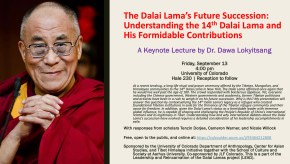
The Dalai Lama’s Future Succession: Understanding the 14th Dalai Lama and His Formidable Contributions, a keynote lecture by Dr. Dawa Lokyitsang

by

This keynote lecture by Dr. Dawa Lokyitsang on “The Dalai Lama’s Future Succession: Understanding the 14th Dalai Lama and His Formidable Contributions” with responses from Tenzin Dorjee (Columbia University), Cameron Warner (Aarhus University), and Nicole Willock (Old Dominion University) took place on September 13, 2024 at the University of Colorado Boulder’s Department of Anthropology. This lecture is part of the Leadership and Reincarnation of the Dalai Lamas Project (LEAD): A Research Network on Succession, Innovation, and Community.

Lhasa Ballers: A Conversation with Tenzin Wangchuk, Founder of New Clothing Line, Union of Prophets

by

Tenzin Wangchuk, A.K.A. Exiled Prophet, is a New York based Tibetan rapper and creative force behind the newly released clothing line, Union of Prophets. I sat down with Wangchuk recently to discuss his transition from rapper to designer. We met for dinner in Jackson Heights, at one of my favorite restaurants, Little Tibet, and discussed everything from the origins of American Hip Hop and it’s universal themes, his aspirations as a designer and activist, to addressing his concerns about the appropriation of Hip Hop and Black culture.

New Spaces For Tibetan Art: A Conversation With Nyema Droma, Founder of Himaalaya Studio Lhasa

by

Nyema Droma is a Lhasa based photographer and recent graduate of the London College of Fashion, where she studied fashion styling and photography. Last summer I had the opportunity to attend her senior… Continue reading

Consumerist Buddhist

by

[Guestpost by Kunsang Palmo] I had sat with the White Buddhists for at least thirty minutes. It was a frustrating experience. I sat in silence watching the gross fetishization of Tibetan Buddhism. I… Continue reading

When Tibetan Women ruled Tibet

by

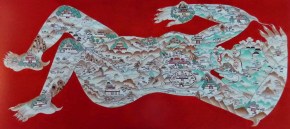
she realizes the demoness Srin, who represents the Tibetan landscape itself, is causing all the difficulties. To subdue her, they build a total of thirteen Buddhist temples, some of which still stand today in places like Bhutan (39), to pin her down on her back. Four in the inner realm of Tibet to pin her shoulder and hip. Four at the border areas, pinning her knees and elbows. Four at the boarders beyond to pin her hands and feet. And finally, one at the Jo-khang, symbolizing her heart and considered the center of Tibet (38). Thus Srin is subdued and Buddhism can reign over Tibet. Besides Buddhist domination of Srin, what is this myth really about? And why is the demoness gendered as female?

Adapting to Survive in a New Exile

by

[Guest post by Ngawang Lodoe, a student from Hampshire College, did his final photography project on the preservation and challenges of the Tibetan culture and language in the US.] The story of Tibet… Continue reading

For You, Our Beloved Tenzin Delek Rinpoche

by

Tenzin Delek Rinpoche died under suspicious circumstances in a Chinese prison in Eastern Tibet earlier this week. His family shared this news with the rest of the world on Monday July 12, 2015. All… Continue reading

Escaping Home

by

  I woke up in the middle of the night. The sound of Dhomsey’s deep barks had taken me from such a wonderful dream. An escape. Dhomsey never barks, so I slowly got… Continue reading