Category Archive: Ethnicity

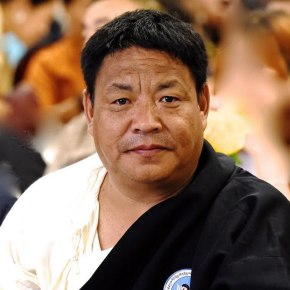
Lobga Rangzen’s Self-Immolation in New York and the Roots of China’s New “Ethnic Unity” Law

by

Like those before him, Rangzen’s testimony makes clear that this new law is the latest assault among a series of other policies implemented in Tibet under the banner of national unity and security that have legalized the systemic elimination of Tibetan culture and identity. These laws highlight the structural nature of China’s ethnic elimination policy in favor of national hegemony. This is despite the rights of language and culture guaranteed to ethnic minorities in the People’s Republic of China’s Constitution and the Regional Ethnic Autonomy Law.

His method of protest was informed and inspired by other Tibetan self-immolations, and like them, his action was both a response to and shaped by a life of dispossession under policies rooted in China’s colonial approach to ethnic governance in Tibet.

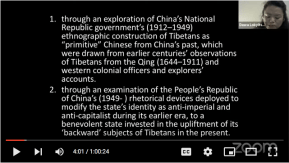
Lecture at UCLA on Chinese Colonialism in Tibet

by

The following is video of a lecture I gave at UCLA’s (The University of California, Los Angeles) Asia Pacific Center November 5, 2021, 12:00 PM – 1:00 PM (Pacific Time).

The Discursive Art of China’s Colonialism: Reconfiguring Tibetan and State Identities

by

How do present forms of colonialisms persist in what is presumed to be the ‘post’ colonial era? One-way colonialism persists in the current era is through the state’s ‘modification’ of its identity according to Indigenous studies scholar Glen Coulthard (2014). Scholars of Empire studies have long stressed how the colonial state constructs its own identity in the process of constructing the identities of its colony and subjects (Cooper and Stoler 1997, Stoler 2010). In this article, I consider this question through the framework of Tibet and China and ask, how is China’s current relationship to Tibet understood as state and subject, rather than colonizer and colonized? In the following, I suggest this in part has to do with how Tibetans are understood to be ‘Chinese’ in the present moment. Through a careful examination of China’s different and successive government’s discursive and rhetorical mechanisms, I explore how Tibetan identity is reinvented and state identity modified to construct Tibet in China’s national imagination as part of China. Such reconfiguration of identities, which centers the history of Tibet’s development through Chinese frameworks rather than Tibetan ones, function to counter and erase past and ongoing histories of Tibetan nationalism that continually challenge China’s sovereign claims over Tibet. The discursive ramification of such state-produced historical erasures and identity reconfigurations is that it allows modern nation states such as China to operationalize systematic colonialisms in its colonies while distancing itself from its colonial identity. This is how present forms of colonialisms under new modern orders continue to function anew in what is presumed to be the ‘post’ colonial era.