Category Archive: Diaspora

Tsering Yangzom Lama, Dawa Lokyitsang and Natalie Avalos at Jaipur Lit Festival

by

Long term readers of Lhakar Diaries know that Tsering Yangzom Lama is one of our founders. So it is a pleasure to share a video of us in conversation talking about her book, “We Measure the Earth with our Bodies,” and topics such as: the centrality of land in how we as Tibetans imagine and enact ourselves in the world, colonial dispossession, the coloniality of Tibetan Studies and the extractive nature with which some of its scholars engage Tibet/ans, theft of sacred Tibetan objects in the making of expertise and museums, intentionality in Tibetan Buddhist ritual practices of compassion and how its not about just the self but about all.

This conversation took place at the Jaipur Literature Festival in Boulder, CO on September 23rd, 2023.

6 Poems on Life in Exile and Of Home from “A Thousand Parallel Lives” by Tenzin Pema Chashar

by

The first poem “The Young, the Holy, and the Wealthy” is one version of my interpretation from the many stories I’ve been told about how key members of a family, who had been identified for torture/prison/thamzing, were given fair warning from those whose loyalty the Chinese tried to buy but couldn’t. 

The second poem “Here Vs. There” is something I wrote from my memory of listening to the elders talk constantly about how everything was always that much better or more abundant or brighter or bigger (even the ravens, as I recall) in Tibet. So it’s written from the vantage of someone who is about to set off for life in exile and has these hopes for how this new life/home should be.

The third poem “Wait for Me” is something I wrote from the perspective of so many of our parents and elders who had to leave their parents or children and loved ones behind as many of them had to make a hasty escape. However, many stayed somewhere close to the borders, waiting for their loved ones to join them, and not making the final descent into exile because of their belief too that the issue of Tibet would be a temporary one.

The fourth poem “Call to Arms” is about early life in exile when Tibetans in nearly every settlement called on their youth to practice ‘March Past’ every morning (with wooden toy guns) so that they would be ready if ever there was a war with the Chinese.

The fifth poem “Stone Bench” is about life in exile in the 1980’s and 1990’s when the longing for home (where the life they had left behind was home) was still palpable and a focal point of all conversations between the elders.

In honor of the 13th Dalai Lama’s proclamation of Independence: Neglecting the invasion of Tibet in analysis of early exile as ‘Geluk Hegemony’

by

How can we honor the complexities and challenges of our distant past without compromising collective experiences of the recent present? There is value in acknowledges the multi-dimensionality of Tibetan communities and the messiness of making communities in new places, without having to compromise the story of invasion and colonial occupation. How can we focus on what unites us as Tibetans rather than what divides us? Can we even afford such divisiveness at a time when it feels as though Tibet is experiencing an intensification of colonial incorporation and exile is stretched to its limits in diaspora with confusing political alignments that does not address Chinese colonialism?

Future of Tibet: Thoughts and Observations

by

The following is a video of the short talk I gave the conference “Future of Tibet” in Paris on FRIDAY 25 November, 2022. I share my observation on political developments within the diaspora community, the rise of Tibet advocacy in the governments of Canada and the United States through their parliament structures, and the importance of acknowledging the rise of and supporting Tibetan-Canadian and Tibetan-American candidates in the Canadian and American parliaments and the potentiality of their roles in facing China’s espionage activities on American and Canadian soil and advocacy on behalf of Tibet against China.

Sovereignty in Settler Colonial Times on American Ethnologist

by

Prior to exile, Tibetan kinship alliances had tended to function along biological/affinal (clan) and regional (hometown) lines. As I show in this historical and ethnographic essay, the conditions of exile also worked to configure new kinship ties along national lines—communities in exile became family to each other, and in turn, the nation itself was imagined as family.

In exile, schools became key sites in which these novel forms of kinship and belonging were cultivated. In 1960, the Dalai Lama’s administration opened nurseries for children in exile that later became boarding schools (Dalai Lama 1991). Students from this school eventually became adults who sustained the next phase of exile for Tibetans escaping the policies of the Cultural Revolution that were imposed upon Tibet. Today, there are over 70 Tibetan refugee schools in Nepal and India that have graduated over 25,000 students. These educational institutions, which were developed, run, and attended by Tibetans, both sustained and fostered new forms of solidarity and citizenship that in turn bolstered the project of sovereignty-in-exile.

Who is a Pure Tibetan? Identity, Intergenerational History, and Trauma in Exile

by

How do Tibetans themselves conceptualize being Tibetan? Here, I explore this question through an ethnographic illustration of recent public discussions between Tibetans online, and the kinds of reactions these exchanges provoke. Their discussions were often about purity—what makes someone a pure Tibetan? Purity was needed, argued many, to preserve the Tibetan identity. For Tibetans inside and outside Tibet, preservation was a project that Tibetans collectively began after the Chinese invasion. Many saw purity as necessary to promote the project of cultural and identity preservation in colonized Tibet and exile-diaspora. Purity offered possibilities for survival and continuity of the culture. But what does this purity look like?

Are Tibetans Indigenous?

by

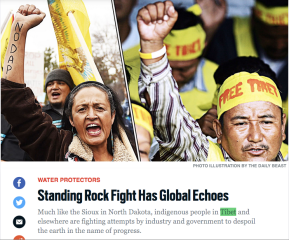
“Are Tibetans Indigenous? It depends who you ask. While Tibetans exposed to Indigenous sovereignty movements such as Idle No More and NoDAPL identify with indigeneity currently, the term was officially rejected decades earlier by the Tibetan apparatus in diaspora. Drawing on recent scholarship by Indigenous scholars, indigeneity as a term was a colonial construct. It was through this racial construction that the settler state proliferated the domination of Indigenous lands and bodies. However, many Indigenous organizers argue that the recent use of the term in mobilizing political solidarity across the globe against imperial-setter colonial-capitalist-governmentality has made the word too essential to abandon all together. Instead, Indigenous scholars have proposed ways of rethinking indigeneity that is decolonial. My paper draws on this scholarship to examine why Tibetans refused to identify as indigenous before yet claim it now. Using an historical approach, I examine the kinds of political stakes that were at risk in claiming the terminology earlier versus now. And why current redefinition of the word appeals to a younger generation of Tibetans growing up exposed to Indigenous movements in North America.”

Consumerist Buddhist

by

[Guestpost by Kunsang Palmo] I had sat with the White Buddhists for at least thirty minutes. It was a frustrating experience. I sat in silence watching the gross fetishization of Tibetan Buddhism. I… Continue reading

Momos in Budapest

by

[Guestpost by Mila Tenzin Samdub]   There is a sign above the door with two flags on it: “Free Kurdistan Free Tibet Gyorsetterem”. Budapest was to be my surrogate Lhasa. I had applied… Continue reading

Dancing in New York

by

A few Lhakar Wednesdays ago, NY & NJ Lhakar team held one of the most (among many) fun celebratory event. According to their Facebook album, they wrote, Gorshey night at heart of Jackson… Continue reading