Understanding Asian Settler-Colonial Imperialisms and Indigeneities, China in Tibet
I recently I published “Are Tibetans Indigenous? The Political Stakes and Potentiality of the Translation of Indigeneity” in ANU Press‘s Made in China Journal: Volume 9, Issue 1, 2024. The issue is titled “Bending Chineseness: Culture and Ethnicity after Xi” January—June 2024. The article is an edited and longer version of my previously published 2017 article “Are Tibetans Indigenous?” on Lhakar Diaries.
I’m sharing an excerpt of the article here on Lhakar Diaries. Below you will find links to the full length article.
***
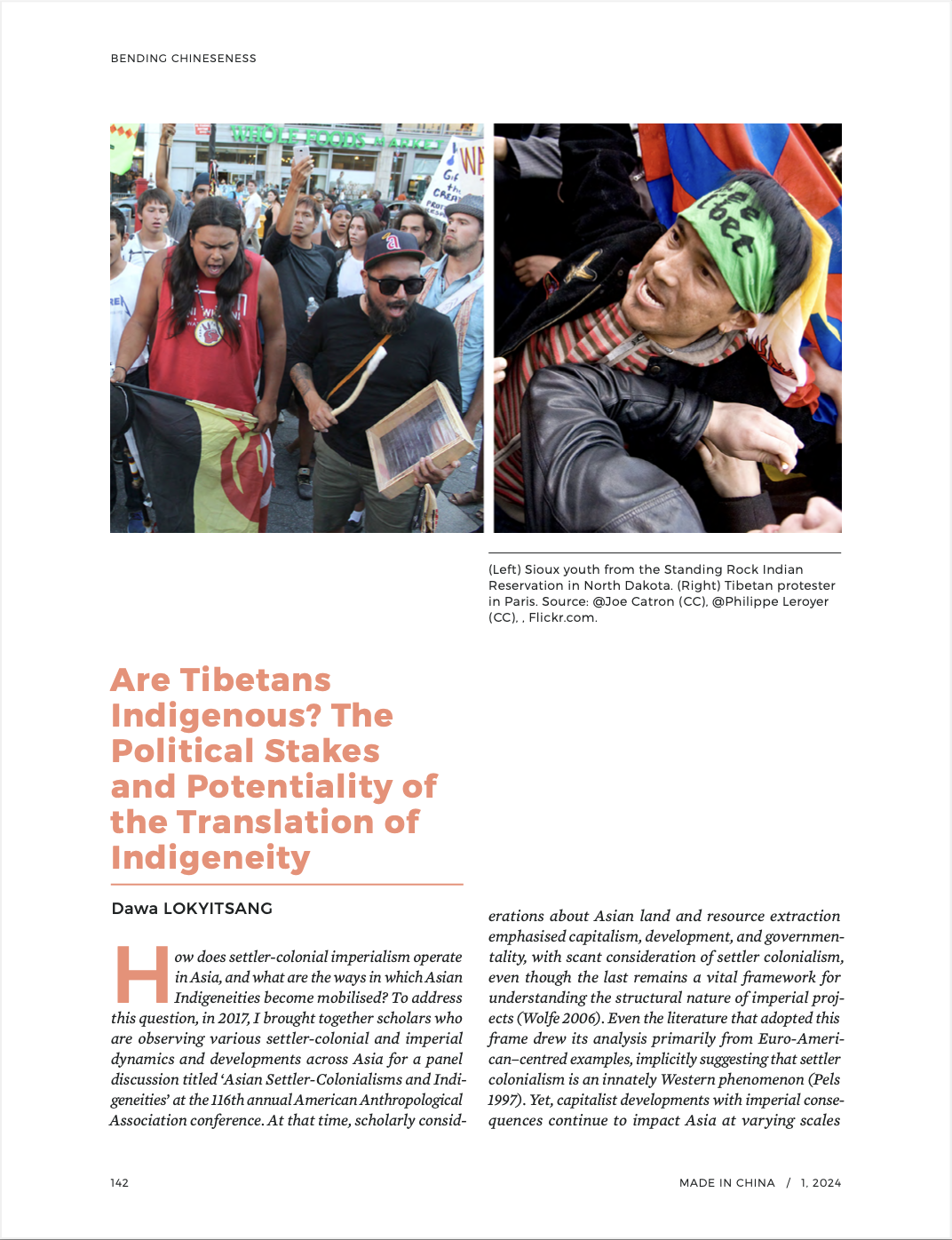
How does settler-colonial imperialism operate in Asia, and what are the ways in which Asian Indigeneities become mobilised? To address this question, in 2017, I brought together scholars who are observing various settler-colonial and imperial dynamics and developments across Asia for a panel discussion titled ‘Asian Settler-Colonialisms and Indigeneities’ at the 116th annual American Anthropological Association conference. At that time, scholarly considerations about Asian land and resource extraction emphasised capitalism, development, and governmentality, with scant consideration of settler colonialism, even though the last remains a vital framework for understanding the structural nature of imperial projects (Wolfe 2006). Even the literature that adopted this frame drew its analysis primarily from Euro-American–centred examples, implicitly suggesting that settler colonialism is an innately Western phenomenon (Pels 1997). Yet, capitalist developments with imperial consequences continue to impact Asia at varying scales (Tsing 2005). Such contemporary developments, alongside long Asian imperial histories, including those of China, Japan, and India, complicate this assumption. This provokes questions such as: How does settler domination work when those involved in it are neither white nor from the West? How can we critically engage with this while not Orientalising this history as a cultural peculiarity or delinking it from the deep influence of Western empires?
With these questions in mind, I drew from recent innovative scholarship in anthropology, Native studies, and ethnic studies to bring attention to the potential of interdisciplinary approaches for rethinking Asian settler colonialisms and indigeneities. For example, how might North American–centred settler-colonialism literature complicate relationships between Asian nation-states and their ‘Indigenous’ populations, especially when the latter, for a multitude of reasons, often do not identify as, nor are categorised as, Indigenous?
In my intervention on that panel I focused on the question: ‘Are Tibetans Indigenous?’ Since I made this article available to the public on the popular online Tibetan platform Lhakar Diaries in 2017, my intervention has influenced other scholars to ask similar questions, including regarding Uyghurs (Musapir and Roberts 2022). Settler colonialism as a topic of interest was even raised at the 2024 Association for Asian Studies conference.
While these developments are encouraging, the central critique I raised in my 2017 article remains valid. As researchers, we should not concern ourselves with whether a group of people do or do not identify as Indigenous. Instead, scholars must highlight the political stakes as well as the potentiality of why a group of people would or would not identify as Indigenous. Doing so will allow researchers to highlight indigeneity as a political concept constructed and contested between settler-colonial governmentalities and Indigenous anticolonial sovereignty movements.
As I stated in my 2017 article, the stakes and potentials of indigeneity as a political category are what concern Tibetans. I highlight why Tibetans in exile rejected and later accepted identification with indigeneity due to the concept’s changing political meanings. Such contestations over the political translation and meaning of indigeneity between settler states and First Nations’ anticolonial land-return movements highlight legal arguments over sovereignty. This is what my article stresses: that although indigeneity as a racial terminology was invented by settler-colonial imperial governmentalities in North America to take possession of First Nations territories and govern their bodies, Indigenous sovereignty movements have redefined and decolonised such racialised renderings to highlight their political potentiality regarding regaining sovereignty. This contestation is what I argue highlights the politicised nature of translating indigeneity.
Hopefully, this clarification will serve as a reminder to those presently considering indigeneity and settler colonialism as an analytic for certain dynamics in Asia to highlight the political stakes and potentialities of translating indigeneity. The terminology of indigeneity may serve as a signifier for ‘the native’ but its political mobilisation between settler-colonial imperial governmentalities and Indigenous anticolonial sovereignty movements highlights how this contestation involves the right to define territorial sovereignty. With this interest in mind, I reintroduce this article for the broader audience of the Made in China Journal.
***
Links to the full article:
- Article on the web: https://madeinchinajournal.com/2024/08/18/are-tibetans-indigenous-the-political-stakes-and-potentiality-of-the-translation-of-indigeneity/
You may source the following article as:
- Lokyitsang, Dawa. 2024. “Are Tibetans Indigenous?: The political stakes and potentiality of the translation of indigeneity.” Made in China Journal 9.1: 142-147.