Tag Archive: History

When Tibetan Women Speak, Are We Heard? Challenging Etic Frameworks in Tibetan Gender Studies

by

There is a growing trend among non-Tibetan scholars—primarily those from Western or Chinese backgrounds—to analyze Tibetan women’s experiences through frameworks focused on gendered roles, marginality, or violence in relation to Tibetan men. I have written about how such analyses often overlook critical and temporal factors, such as intersectionality (Lokyitsang 2015) and the historical and ongoing violence and marginalizing policies imposed by Chinese authorities (Lokyitsang 2017a). Moreover, these scholars rarely interrogate their own etic (outsider) assumptions embedded in their own analytics.

Within these frameworks, Tibetan women’s emic (insider) scholarly perspectives are routinely sidelined—especially when some of us turn the analytical lens back on these scholars to examine the power dynamics of their positionalities, and to critique their uncritical use of categories like “modernity” and “gender empowerment.” These categories, rooted in Western Enlightenment ideals, have already been challenged by Black and Indigenous feminist thinkers as embedded in white supremacist frameworks and serving the interest of imperial projects.

When Tibetan Women ruled Tibet

by

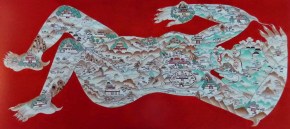
she realizes the demoness Srin, who represents the Tibetan landscape itself, is causing all the difficulties. To subdue her, they build a total of thirteen Buddhist temples, some of which still stand today in places like Bhutan (39), to pin her down on her back. Four in the inner realm of Tibet to pin her shoulder and hip. Four at the border areas, pinning her knees and elbows. Four at the boarders beyond to pin her hands and feet. And finally, one at the Jo-khang, symbolizing her heart and considered the center of Tibet (38). Thus Srin is subdued and Buddhism can reign over Tibet. Besides Buddhist domination of Srin, what is this myth really about? And why is the demoness gendered as female?

The Art of China’s Colonialism: Constructing Invisibilities in Tibetan History and Geography

by

What does an ethnographic discourse on the invisibility of a colonial empire in the 21st century look like? What does that invisibility contribute to, or rather take away from, the experiences of Tibetans inside and outside Tibet? In this post, I examine the historical and contemporary discourses on Tibet that frame Tibet as either not colonized or about human rights, which, I argue, silences Tibetan aspirations for Nationhood. Aside from contextualizing Tibetan subjectivities, I contribute to the ongoing discourse on how ethnographic narratives can re-construct the invisibility of existing colonial empires and justify their presence as a given right rather than foreign.

Mao in Tibetan disguise: History, ethnography, and excess

by

Guest post by Carole MCGRANAHAN, University of Colorado. (The original academic article with footnotes and bibliography can be found and downloaded here at http://www.haujournal.org/index.php/hau/article/view/65) What does ethnographic theory look like in dialogue with… Continue reading