Tag Archive: China

Tibet Film Festival Zurich 2025: Celebrating Tibetan Stories Across Borders

by

I am still reflecting on the wonderful time I had in Zurich at the Tibet Film Festival, thanks to the Tibetan organizers who have nurtured this event since 2009. This was my first time attending, and I had the honor of moderating a discussion with filmmaker Tenzin Tsetan Choklay about his collaborative work State of Statelessness.

What I did not expect was how the theme of statelessness became an avenue for learning about the Swiss Tibetan community.

When Tibetan Women Speak, Are We Heard? Challenging Etic Frameworks in Tibetan Gender Studies

by

There is a growing trend among non-Tibetan scholars—primarily those from Western or Chinese backgrounds—to analyze Tibetan women’s experiences through frameworks focused on gendered roles, marginality, or violence in relation to Tibetan men. I have written about how such analyses often overlook critical and temporal factors, such as intersectionality (Lokyitsang 2015) and the historical and ongoing violence and marginalizing policies imposed by Chinese authorities (Lokyitsang 2017a). Moreover, these scholars rarely interrogate their own etic (outsider) assumptions embedded in their own analytics.

Within these frameworks, Tibetan women’s emic (insider) scholarly perspectives are routinely sidelined—especially when some of us turn the analytical lens back on these scholars to examine the power dynamics of their positionalities, and to critique their uncritical use of categories like “modernity” and “gender empowerment.” These categories, rooted in Western Enlightenment ideals, have already been challenged by Black and Indigenous feminist thinkers as embedded in white supremacist frameworks and serving the interest of imperial projects.


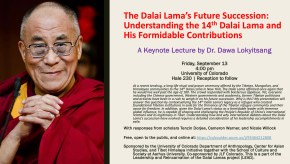
The Dalai Lama’s Future Succession: Understanding the 14th Dalai Lama and His Formidable Contributions, a keynote lecture by Dr. Dawa Lokyitsang

by

This keynote lecture by Dr. Dawa Lokyitsang on “The Dalai Lama’s Future Succession: Understanding the 14th Dalai Lama and His Formidable Contributions” with responses from Tenzin Dorjee (Columbia University), Cameron Warner (Aarhus University), and Nicole Willock (Old Dominion University) took place on September 13, 2024 at the University of Colorado Boulder’s Department of Anthropology. This lecture is part of the Leadership and Reincarnation of the Dalai Lamas Project (LEAD): A Research Network on Succession, Innovation, and Community.

New Spaces For Tibetan Art: A Conversation With Nyema Droma, Founder of Himaalaya Studio Lhasa

by

Nyema Droma is a Lhasa based photographer and recent graduate of the London College of Fashion, where she studied fashion styling and photography. Last summer I had the opportunity to attend her senior… Continue reading

The Unexpected Familiary: Finding Myself in the Kingdom of Lo (Mustang)

by

After two weeks in Boudha, Kathmandu, Nepal, I became bored. I was itching to get out. Several friends on Facebook suggested I check out Sherpa country or Mustang, and then I remembered my… Continue reading

Non-Refugee Refugees: Tibetans’ Struggles for Visibility in Bureaucratic India

by

The struggle for visibility (documents) has always played a central role for Tibetans living in exile, especially for those living in India and Nepal. In this post, I look into this struggle that Tibetans in India face as newly arrived Tibetans from Tibet (second half) and Tibetans born and raised there (first half). During my stays in Dharamsala, India, I came across several different socio-cultural-political-economic phenomenons that have been emerging as a result of the lack of visibility for Tibetans living as, what I refer to as non-refugee refugees, in bureaucratic India. In the following, I take a closer look at one of these emerging intercultural phenomenon currently shaping the possibility of existing on paper for Tibetans especially from Tibet that bureaucratic India has yet to offer.

Canada’s Stance on Tibet’s Independence

by

With today being February 13th, Tibet’s Independence Day, and the 100th anniversary of the day when the 13th Dalai Lama proclaimed the restoration of Tibet’s independence, it got me thinking; while Tibet was… Continue reading

Upholding the Pledge: Lhakar in 2013

by

Happy 2013 to all our readers out there! Now that the holidays are over it’s back to work here at LD. After a long and busy holiday I thought what better way to… Continue reading

The Art of China’s Colonialism: Constructing Invisibilities in Tibetan History and Geography

by

What does an ethnographic discourse on the invisibility of a colonial empire in the 21st century look like? What does that invisibility contribute to, or rather take away from, the experiences of Tibetans inside and outside Tibet? In this post, I examine the historical and contemporary discourses on Tibet that frame Tibet as either not colonized or about human rights, which, I argue, silences Tibetan aspirations for Nationhood. Aside from contextualizing Tibetan subjectivities, I contribute to the ongoing discourse on how ethnographic narratives can re-construct the invisibility of existing colonial empires and justify their presence as a given right rather than foreign.

Fear of the Unknown

by

For the past month, as the number of self-immolations climbed, my adviser and I sat down several times, trying to figure out activities we can do to highlight the situation better here at the University I’m currently studying at. Then last week, I saw the video campaign with messages to world leaders launched by SFT spreading in the web-sphere.