Category Archive: History

Understanding Asian Settler-Colonial Imperialisms and Indigeneities, China in Tibet

by

From the article: Are Tibetans Indigenous? The Political Stakes and Potentiality of the Translation of Indigeneity

How does settler-colonial imperialism operate in Asia, and what are the ways in which Asian Indigeneities become mobilised? To address this question, in 2017, I brought together scholars who are observing various settler-colonial and imperial dynamics and developments across Asia for a panel discussion titled ‘Asian Settler-Colonialisms and Indigeneities’ at the 116th annual American Anthropological Association conference. At that time, scholarly considerations about Asian land and resource extraction emphasised capitalism, development, and governmentality, with scant consideration of settler colonialism, even though the last remains a vital framework for understanding the structural nature of imperial projects (Wolfe 2006). Even the literature that adopted this frame drew its analysis primarily from Euro-American–centred examples, implicitly suggesting that settler colonialism is an innately Western phenomenon (Pels 1997). Yet, capitalist developments with imperial consequences continue to impact Asia at varying scales (Tsing 2005). Such contemporary developments, alongside long Asian imperial histories, including those of China, Japan, and India, complicate this assumption. This provokes questions such as: How does settler domination work when those involved in it are neither white nor from the West? How can we critically engage with this while not Orientalising this history as a cultural peculiarity or delinking it from the deep influence of Western empires?

Tsering Yangzom Lama, Dawa Lokyitsang and Natalie Avalos at Jaipur Lit Festival

by

Long term readers of Lhakar Diaries know that Tsering Yangzom Lama is one of our founders. So it is a pleasure to share a video of us in conversation talking about her book, “We Measure the Earth with our Bodies,” and topics such as: the centrality of land in how we as Tibetans imagine and enact ourselves in the world, colonial dispossession, the coloniality of Tibetan Studies and the extractive nature with which some of its scholars engage Tibet/ans, theft of sacred Tibetan objects in the making of expertise and museums, intentionality in Tibetan Buddhist ritual practices of compassion and how its not about just the self but about all.

This conversation took place at the Jaipur Literature Festival in Boulder, CO on September 23rd, 2023.

6 Poems on Life in Exile and Of Home from “A Thousand Parallel Lives” by Tenzin Pema Chashar

by

The first poem “The Young, the Holy, and the Wealthy” is one version of my interpretation from the many stories I’ve been told about how key members of a family, who had been identified for torture/prison/thamzing, were given fair warning from those whose loyalty the Chinese tried to buy but couldn’t. 

The second poem “Here Vs. There” is something I wrote from my memory of listening to the elders talk constantly about how everything was always that much better or more abundant or brighter or bigger (even the ravens, as I recall) in Tibet. So it’s written from the vantage of someone who is about to set off for life in exile and has these hopes for how this new life/home should be.

The third poem “Wait for Me” is something I wrote from the perspective of so many of our parents and elders who had to leave their parents or children and loved ones behind as many of them had to make a hasty escape. However, many stayed somewhere close to the borders, waiting for their loved ones to join them, and not making the final descent into exile because of their belief too that the issue of Tibet would be a temporary one.

The fourth poem “Call to Arms” is about early life in exile when Tibetans in nearly every settlement called on their youth to practice ‘March Past’ every morning (with wooden toy guns) so that they would be ready if ever there was a war with the Chinese.

The fifth poem “Stone Bench” is about life in exile in the 1980’s and 1990’s when the longing for home (where the life they had left behind was home) was still palpable and a focal point of all conversations between the elders.

In honor of the 13th Dalai Lama’s proclamation of Independence: Neglecting the invasion of Tibet in analysis of early exile as ‘Geluk Hegemony’

by

How can we honor the complexities and challenges of our distant past without compromising collective experiences of the recent present? There is value in acknowledges the multi-dimensionality of Tibetan communities and the messiness of making communities in new places, without having to compromise the story of invasion and colonial occupation. How can we focus on what unites us as Tibetans rather than what divides us? Can we even afford such divisiveness at a time when it feels as though Tibet is experiencing an intensification of colonial incorporation and exile is stretched to its limits in diaspora with confusing political alignments that does not address Chinese colonialism?

Future of Tibet: Thoughts and Observations

by

The following is a video of the short talk I gave the conference “Future of Tibet” in Paris on FRIDAY 25 November, 2022. I share my observation on political developments within the diaspora community, the rise of Tibet advocacy in the governments of Canada and the United States through their parliament structures, and the importance of acknowledging the rise of and supporting Tibetan-Canadian and Tibetan-American candidates in the Canadian and American parliaments and the potentiality of their roles in facing China’s espionage activities on American and Canadian soil and advocacy on behalf of Tibet against China.

Sovereignty in Settler Colonial Times on American Ethnologist

by

Prior to exile, Tibetan kinship alliances had tended to function along biological/affinal (clan) and regional (hometown) lines. As I show in this historical and ethnographic essay, the conditions of exile also worked to configure new kinship ties along national lines—communities in exile became family to each other, and in turn, the nation itself was imagined as family.

In exile, schools became key sites in which these novel forms of kinship and belonging were cultivated. In 1960, the Dalai Lama’s administration opened nurseries for children in exile that later became boarding schools (Dalai Lama 1991). Students from this school eventually became adults who sustained the next phase of exile for Tibetans escaping the policies of the Cultural Revolution that were imposed upon Tibet. Today, there are over 70 Tibetan refugee schools in Nepal and India that have graduated over 25,000 students. These educational institutions, which were developed, run, and attended by Tibetans, both sustained and fostered new forms of solidarity and citizenship that in turn bolstered the project of sovereignty-in-exile.

Lecture at UCLA on Chinese Colonialism in Tibet

by

The following is video of a lecture I gave at UCLA’s (The University of California, Los Angeles) Asia Pacific Center November 5, 2021, 12:00 PM – 1:00 PM (Pacific Time).

Decolonizing ‘Tibetan’ Studies: Empire, Ethnicity, and Rethinking Sovereignty at Humboldt University

by

Who are Tibetans? How have they been framed as objects for study across time? For earlier Western academics and the audiences who read their work, Tibetans were a people largely defined by religious beliefs and institutions. In this presentation, I argue that this emphasis in early Tibetan Studies set a precedent for sidelining Tibetan sovereignty as a central concern in both scholarship and in real world politics, a trend which continues to impact the field and Tibetan lives today. While researchers were interested in understanding the structural authority and functions of the sovereign, their Orientalizing renderings often sidelined analysis of Tibet’s geopolitical history and developments in central Asia as an empire and nation. This deprioritizing necessarily ignores the rich body of Indigenous history transmitted through literary production and oral traditions produced by Tibetans for Tibetan audiences that dates back centuries. A chronological examination of scholarly productions on Tibet undertaken predominantly by Western scholars reveals the making of Tibetan Studies as a Western academic subject based on ideas and interpretations of Tibetans by Westerners. Similarly, modern Chinese scholarship on Tibet has been heavily influenced by Orientalist Western traditions. Both demonstrate the importance of acknowledging histories of representation.

The Discursive Art of China’s Colonialism: Reconfiguring Tibetan and State Identities

by

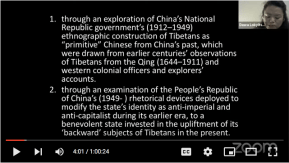
How do present forms of colonialisms persist in what is presumed to be the ‘post’ colonial era? One-way colonialism persists in the current era is through the state’s ‘modification’ of its identity according to Indigenous studies scholar Glen Coulthard (2014). Scholars of Empire studies have long stressed how the colonial state constructs its own identity in the process of constructing the identities of its colony and subjects (Cooper and Stoler 1997, Stoler 2010). In this article, I consider this question through the framework of Tibet and China and ask, how is China’s current relationship to Tibet understood as state and subject, rather than colonizer and colonized? In the following, I suggest this in part has to do with how Tibetans are understood to be ‘Chinese’ in the present moment. Through a careful examination of China’s different and successive government’s discursive and rhetorical mechanisms, I explore how Tibetan identity is reinvented and state identity modified to construct Tibet in China’s national imagination as part of China. Such reconfiguration of identities, which centers the history of Tibet’s development through Chinese frameworks rather than Tibetan ones, function to counter and erase past and ongoing histories of Tibetan nationalism that continually challenge China’s sovereign claims over Tibet. The discursive ramification of such state-produced historical erasures and identity reconfigurations is that it allows modern nation states such as China to operationalize systematic colonialisms in its colonies while distancing itself from its colonial identity. This is how present forms of colonialisms under new modern orders continue to function anew in what is presumed to be the ‘post’ colonial era.

Who is a Pure Tibetan? Identity, Intergenerational History, and Trauma in Exile

by

How do Tibetans themselves conceptualize being Tibetan? Here, I explore this question through an ethnographic illustration of recent public discussions between Tibetans online, and the kinds of reactions these exchanges provoke. Their discussions were often about purity—what makes someone a pure Tibetan? Purity was needed, argued many, to preserve the Tibetan identity. For Tibetans inside and outside Tibet, preservation was a project that Tibetans collectively began after the Chinese invasion. Many saw purity as necessary to promote the project of cultural and identity preservation in colonized Tibet and exile-diaspora. Purity offered possibilities for survival and continuity of the culture. But what does this purity look like?