Category Archive: Decolonize

Tsering Yangzom Lama, Dawa Lokyitsang and Natalie Avalos at Jaipur Lit Festival

by

Long term readers of Lhakar Diaries know that Tsering Yangzom Lama is one of our founders. So it is a pleasure to share a video of us in conversation talking about her book, “We Measure the Earth with our Bodies,” and topics such as: the centrality of land in how we as Tibetans imagine and enact ourselves in the world, colonial dispossession, the coloniality of Tibetan Studies and the extractive nature with which some of its scholars engage Tibet/ans, theft of sacred Tibetan objects in the making of expertise and museums, intentionality in Tibetan Buddhist ritual practices of compassion and how its not about just the self but about all.

This conversation took place at the Jaipur Literature Festival in Boulder, CO on September 23rd, 2023.

6 Poems on Life in Exile and Of Home from “A Thousand Parallel Lives” by Tenzin Pema Chashar

by

The first poem “The Young, the Holy, and the Wealthy” is one version of my interpretation from the many stories I’ve been told about how key members of a family, who had been identified for torture/prison/thamzing, were given fair warning from those whose loyalty the Chinese tried to buy but couldn’t. 

The second poem “Here Vs. There” is something I wrote from my memory of listening to the elders talk constantly about how everything was always that much better or more abundant or brighter or bigger (even the ravens, as I recall) in Tibet. So it’s written from the vantage of someone who is about to set off for life in exile and has these hopes for how this new life/home should be.

The third poem “Wait for Me” is something I wrote from the perspective of so many of our parents and elders who had to leave their parents or children and loved ones behind as many of them had to make a hasty escape. However, many stayed somewhere close to the borders, waiting for their loved ones to join them, and not making the final descent into exile because of their belief too that the issue of Tibet would be a temporary one.

The fourth poem “Call to Arms” is about early life in exile when Tibetans in nearly every settlement called on their youth to practice ‘March Past’ every morning (with wooden toy guns) so that they would be ready if ever there was a war with the Chinese.

The fifth poem “Stone Bench” is about life in exile in the 1980’s and 1990’s when the longing for home (where the life they had left behind was home) was still palpable and a focal point of all conversations between the elders.

Interview on Gender and Leadership in the Tibetan Exile Community

by

Interview for the Central Tibetan Administration’s (or the Tibetan government in exile) “Tibetan Women’s Day” 2020 in Dharamsala, India.

Topics disused: women’s leadership, notions of empowerment, spiritual liberation, gender violence, neoliberalism, colonial violence, exile, alienation

Lecture at UCLA on Chinese Colonialism in Tibet

by

The following is video of a lecture I gave at UCLA’s (The University of California, Los Angeles) Asia Pacific Center November 5, 2021, 12:00 PM – 1:00 PM (Pacific Time).

Decolonizing ‘Tibetan’ Studies: Empire, Ethnicity, and Rethinking Sovereignty at Humboldt University

by

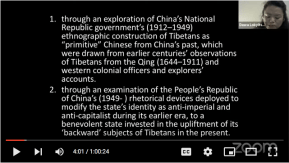
Who are Tibetans? How have they been framed as objects for study across time? For earlier Western academics and the audiences who read their work, Tibetans were a people largely defined by religious beliefs and institutions. In this presentation, I argue that this emphasis in early Tibetan Studies set a precedent for sidelining Tibetan sovereignty as a central concern in both scholarship and in real world politics, a trend which continues to impact the field and Tibetan lives today. While researchers were interested in understanding the structural authority and functions of the sovereign, their Orientalizing renderings often sidelined analysis of Tibet’s geopolitical history and developments in central Asia as an empire and nation. This deprioritizing necessarily ignores the rich body of Indigenous history transmitted through literary production and oral traditions produced by Tibetans for Tibetan audiences that dates back centuries. A chronological examination of scholarly productions on Tibet undertaken predominantly by Western scholars reveals the making of Tibetan Studies as a Western academic subject based on ideas and interpretations of Tibetans by Westerners. Similarly, modern Chinese scholarship on Tibet has been heavily influenced by Orientalist Western traditions. Both demonstrate the importance of acknowledging histories of representation.

Are Tibetans Indigenous?

by

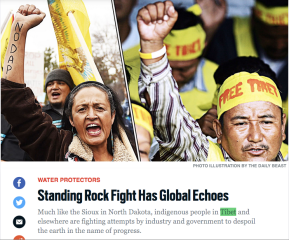
“Are Tibetans Indigenous? It depends who you ask. While Tibetans exposed to Indigenous sovereignty movements such as Idle No More and NoDAPL identify with indigeneity currently, the term was officially rejected decades earlier by the Tibetan apparatus in diaspora. Drawing on recent scholarship by Indigenous scholars, indigeneity as a term was a colonial construct. It was through this racial construction that the settler state proliferated the domination of Indigenous lands and bodies. However, many Indigenous organizers argue that the recent use of the term in mobilizing political solidarity across the globe against imperial-setter colonial-capitalist-governmentality has made the word too essential to abandon all together. Instead, Indigenous scholars have proposed ways of rethinking indigeneity that is decolonial. My paper draws on this scholarship to examine why Tibetans refused to identify as indigenous before yet claim it now. Using an historical approach, I examine the kinds of political stakes that were at risk in claiming the terminology earlier versus now. And why current redefinition of the word appeals to a younger generation of Tibetans growing up exposed to Indigenous movements in North America.”

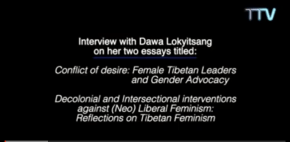
Decolonial & Intersectional Interventions against (Neo)Liberal Feminism: Reflections on Tibetan Feminisms

by

Over the course of few years, the Tibetan diaspora has seen a sharp rise in the number of Tibetan women who claim a feminist identity. What is Tibetan feminism, and how did it emerge? In the following, I track the rise of Tibetan feminism through the development of an online initiative called Tibetan Feminist Collective (TFC) based mostly in the west. Although TFC does not represent the diverse viewpoints of all women who identify as Tibetan and feminist, their version of feminism nonetheless becomes important to engage due to the initiative’s choice in leading and representing discussions regarding Tibetan feminism in Tibetan and non-Tibetan cyber and/or real worlds. Even though I use TFC as a Tibetan example of neoliberal feminism, they are not the only ones influenced by it. Other Tibetan women (alongside their male peers) not affiliated with TFC are also engaging neoliberal ideologies in shaping their individual pathways towards favorable professional outcomes that benefit themselves alone. Today we live in a world where the commodification of identities and activism, thanks to neoliberal ideologies, are so pervasive. Thus, it is important to think critically about the way neoliberalism shapes feminism (and other frameworks), and compromises their liberatory potential.

Tare Lhamo and Namtrul Rinpoche: Courtship & Healing in times of (Cultural Revolution) Degeneration

by

As discussed in previous chapters of Love Letters from Golok: A Tantric Couple in Modern Tibet, Holly Gayley stresses how Tare Lhamo and Namtrul Rinpoche saw their religious engagement and activities in tandem with reviving Tibetan Buddhist culture following the destruction of the Chinese-led Cultural Revolution. Before Tare Lhamo and Namtrul Rinpoche began their activities in reviving Tibetan Buddhism during the 1980s and 1990s together as a tantric couple, they began their official courtship through letters in the 1970s. These letters from the 1970s played a crucial role, argues Gayley, in shaping the couple’s future activities that came to fruition later. The following chapters engage these letters closely to consider how the couple came to view one another and their future together as a tantric couple who would embark on healing Tibetan traumas through Indigenous and Buddhist idioms.

The Exceptional Tare Lhamo: Transcending Gender Through Agentive Means

by

This is a continuation of my project to engage historic female figures of Tibet. Tare Lhamo is especially interesting because she was born before China’s invasion of Tibet, she lived through the invasion, followed by Culture Revolution until its end, and was part of the religious cohort in Tibet who began reviving Tibetan Buddhism from the destruction of Culture Revolution. She becomes an important figure to consider when we think about different subjectivities of Tibetan women in Tibetan history. I hope you’ll find the following analysis useful.

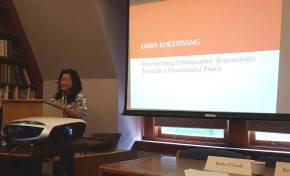
Decolonizing Ethnographic ‘Responsibility’: Towards a Decolonized Praxis

by

what happens when the question of responsibility becomes one of obligation; choice becomes necessity, and crisis exists as an everyday reality?