Category Archive: Tibetan Studies

On translation with Janet Gyatso, Dawa Lokyitsang, & Amy Langenberg, and the importance of Listening

by

This panel workshop on Translation at Northwestern University began with a short introduction of what Janet, Amy, and I (in this order) mean when we say “Inclusive/feminist approaches to Buddhist translations” and shared a list of questions to generate discussion for the audience.

The audio of the session is available for listening.

I also suggest we practice active listening and be aware of our own and other’s gendered, racialized, and classed positionalities if we truly want Tibetan women to be part of the conversation in white-dominated spaces.

6 Poems on Life in Exile and Of Home from “A Thousand Parallel Lives” by Tenzin Pema Chashar

by

The first poem “The Young, the Holy, and the Wealthy” is one version of my interpretation from the many stories I’ve been told about how key members of a family, who had been identified for torture/prison/thamzing, were given fair warning from those whose loyalty the Chinese tried to buy but couldn’t. 

The second poem “Here Vs. There” is something I wrote from my memory of listening to the elders talk constantly about how everything was always that much better or more abundant or brighter or bigger (even the ravens, as I recall) in Tibet. So it’s written from the vantage of someone who is about to set off for life in exile and has these hopes for how this new life/home should be.

The third poem “Wait for Me” is something I wrote from the perspective of so many of our parents and elders who had to leave their parents or children and loved ones behind as many of them had to make a hasty escape. However, many stayed somewhere close to the borders, waiting for their loved ones to join them, and not making the final descent into exile because of their belief too that the issue of Tibet would be a temporary one.

The fourth poem “Call to Arms” is about early life in exile when Tibetans in nearly every settlement called on their youth to practice ‘March Past’ every morning (with wooden toy guns) so that they would be ready if ever there was a war with the Chinese.

The fifth poem “Stone Bench” is about life in exile in the 1980’s and 1990’s when the longing for home (where the life they had left behind was home) was still palpable and a focal point of all conversations between the elders.

Lecture at UCLA on Chinese Colonialism in Tibet

by

The following is video of a lecture I gave at UCLA’s (The University of California, Los Angeles) Asia Pacific Center November 5, 2021, 12:00 PM – 1:00 PM (Pacific Time).

Decolonizing ‘Tibetan’ Studies: Empire, Ethnicity, and Rethinking Sovereignty at Humboldt University

by

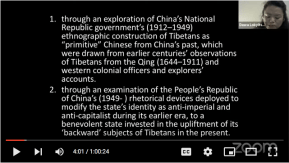
Who are Tibetans? How have they been framed as objects for study across time? For earlier Western academics and the audiences who read their work, Tibetans were a people largely defined by religious beliefs and institutions. In this presentation, I argue that this emphasis in early Tibetan Studies set a precedent for sidelining Tibetan sovereignty as a central concern in both scholarship and in real world politics, a trend which continues to impact the field and Tibetan lives today. While researchers were interested in understanding the structural authority and functions of the sovereign, their Orientalizing renderings often sidelined analysis of Tibet’s geopolitical history and developments in central Asia as an empire and nation. This deprioritizing necessarily ignores the rich body of Indigenous history transmitted through literary production and oral traditions produced by Tibetans for Tibetan audiences that dates back centuries. A chronological examination of scholarly productions on Tibet undertaken predominantly by Western scholars reveals the making of Tibetan Studies as a Western academic subject based on ideas and interpretations of Tibetans by Westerners. Similarly, modern Chinese scholarship on Tibet has been heavily influenced by Orientalist Western traditions. Both demonstrate the importance of acknowledging histories of representation.